
- Details
- Written by: Matt Palmeter
- Category: Flying birds
- Hits: 117
PEREGRINE FALCON
Taken from wikipedia
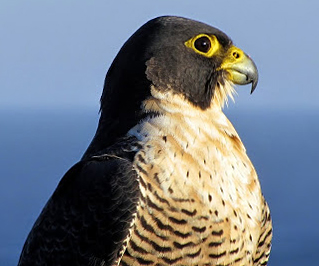
The peregrine falcon (Falco peregrinus), also known simply as the peregrine,[3] is a cosmopolitan bird of prey (raptor) in the family Falconidae renowned for its speed. A large, crow-sized falcon, it has a blue-grey back, barred white underparts and a black head. As is typical for bird-eating (avivore) raptors, peregrine falcons are sexually dimorphic, with females being considerably larger than males.[4][5] Historically, the bird has also been known as the "black-cheeked falcon" in Australia,[6] and the "duck hawk" in North America.[7]
The breeding range includes land regions from the Arctic tundra to the tropics. It can be found nearly everywhere on Earth, except extreme polar regions, very high mountains, and most tropical rainforests. The only major ice-free landmass from which it is entirely absent is New Zealand. That makes it the world's most widespread raptor[8] and one of the most widely found wild bird species. In fact, the only land-based bird species found over a larger geographic area, domestic and feral pigeons, owe their success to human-led introduction. Both are domesticated forms of the rock dove, and are a major prey species for peregrine populations. Due to their greater abundance in cities than most other birds, feral pigeons support many peregrine populations as a staple food source, especially in urban settings
- Details
- Written by: Matt Palmeter
- Category: Flying birds
- Hits: 166
RUBY THROATED HUMMINGBIRD
Taken from Wikipedia
The ruby-throated hummingbird (Archilochus colubris) is a species of hummingbird that generally spends the winter in Central America, Mexico, and Florida, and migrates to Canada and other parts of Eastern North America for the summer to breed. It is the most common hummingbird in eastern North America, having population estimates of about 35 million in 2021.

- Details
- Written by: Matt Palmeter
- Category: Flying birds
- Hits: 325
Taken from wikipedia
The superb fairywren (Malurus cyaneus) is a passerine bird in the Australasian wren family, Maluridae, and is common and familiar across south-eastern Australia. It is a sedentary and territorial species, also exhibiting a high degree of sexual dimorphism; the male in breeding plumage has a striking bright blue forehead, ear coverts, mantle, and tail, with a black mask and black or dark blue throat. Non-breeding males, females and juveniles are predominantly grey-brown in colour; this gave the early impression that males were polygamous, as all dull-coloured birds were taken for females. Six subspecies groups are recognized: three larger and darker forms from Tasmania, Flinders and King Island respectively, and three smaller and paler forms from mainland Australia and Kangaroo Island.
Like other fairywrens, the superb fairywren is notable for several peculiar behavioural characteristics; the birds are socially monogamous and sexually promiscuous, meaning that although they form pairs between one male and one female, each partner will mate with other individuals and even assist in raising the young from such pairings. Male wrens pluck yellow petals and display them to females as part of a courtship display.
The superb fairywren can be found in almost any area that has at least a little dense undergrowth for shelter, including grasslands with scattered shrubs, moderately thick forest, woodland, heaths, and domestic gardens. It has adapted well to the urban environment and is common in suburban Sydney, Canberra, Melbourne and Brisbane. The superb fairywren eats mostly insects and supplements its diet with seeds.

Thing Two
This is a thing under an Anchor, for selection via the top menu
- Details
- Written by: Matt Palmeter
- Category: Flying birds
- Hits: 162
AUSTRALIAN MAGPIE
Taken from Wikipedia
The adult Australian magpie is a fairly robust bird ranging from 37 to 43 cm (14.5 to 17 in) in length, with black and white plumage, gold brown eyes and a solid wedge-shaped bluish-white and black bill. The male and female are similar in appearance, but can be distinguished by differences in back markings. The male has pure white feathers on the back of the head where the female has white blending to grey feathers. With its long legs, the Australian magpie walks rather than waddles or hops and spends much time on the ground.
Described as one of Australia's most accomplished songbirds, the Australian magpie has an array of complex vocalisations. It is omnivorous, with the bulk of its varied diet made up of invertebrates. It is generally sedentary and territorial throughout its range. Common and widespread, it has adapted well to human habitation and is a familiar bird of parks, gardens and farmland in Australia and New Guinea. This species is commonly fed by households around Australia, but in spring (and occasionally in autumn) a small minority of breeding magpies (almost always males) become aggressive, swooping and attacking those who approach their nests. Research has shown that magpies can recognise at least 100 different people, and may be less likely to swoop individuals they have befriended.[5]
